
Electric Gate Stuck Open or Closed in Hallandale Beach?
Here’s Why and How to Fix It
Fast, reliable garage door and electric gate repair and installation in South Florida — call today, fixed today.
What’s Covered on This Page
- Common Reasons an Electric Gate Gets Stuck
- What A Stuck Gate Typically Indicates About The Motor And Control Board
- Why does my electric gate in Hallandale Beach keep stopping halfway?
- Can salt air really damage my electric gate?
- When should I call a professional instead of fixing my electric gate myself?
- Is it true that dead batteries are a common reason electric gates stop working?
- What is a photo-eye sensor and why would it keep my gate stuck open?
- How does Hallandale Beach’s summer heat affect electric gate motors?
Need electric gate stuck open or closed? here’s why and how to fix it?
Call now for a free estimate. Call On Time Garage Door Repair now.
Common Reasons an Electric Gate Gets Stuck
In Hallandale Beach, we hear about this issue on a weekly basis. Whether an electric gate refuses to open or fails to close, it often finds people trapped in their driveways, running late for work, and puzzled as to why they have this issue. The reality is that many of these situations can be boiled down to several problems that we come across frequently.
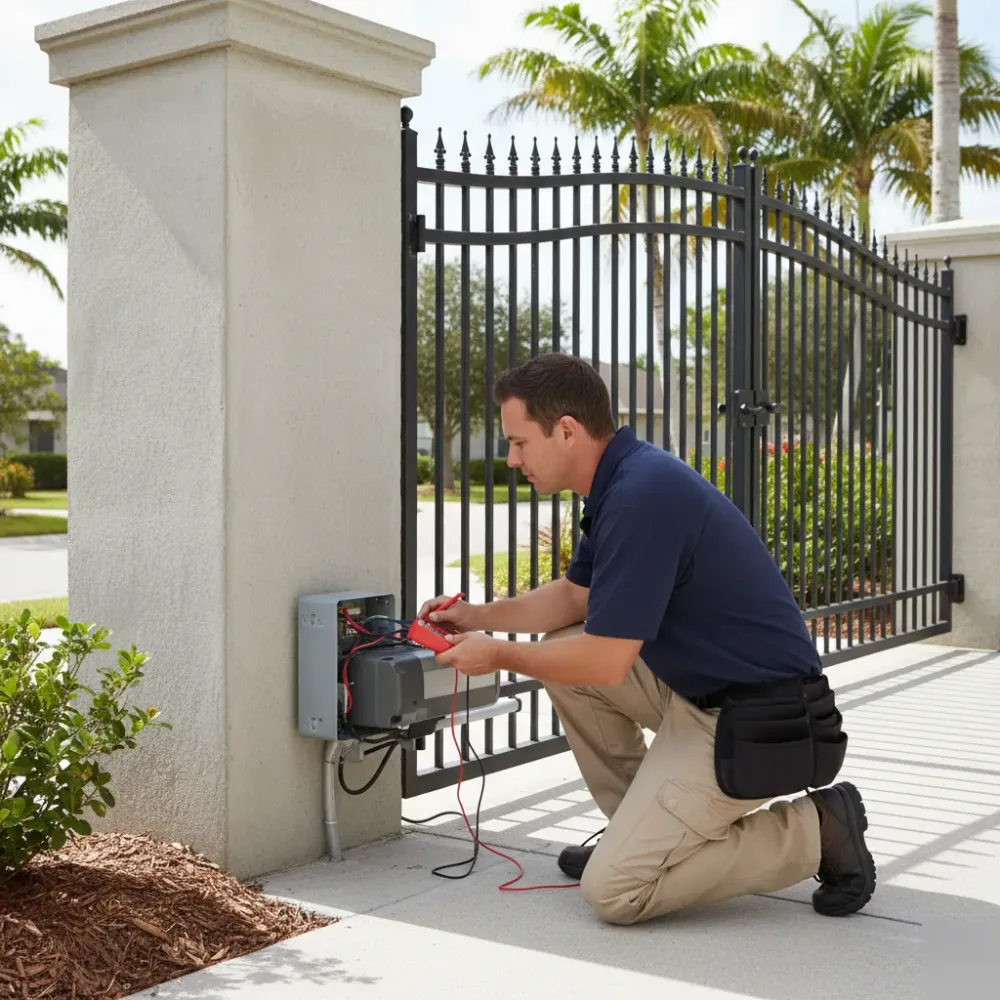
These are just a few of the typical causes of gate malfunctions.
- A track or path for the gate is obstructed. When debris such as leaves, rocks, garbage, or a child’s toy ends up in the path of a sliding gate, it will come to a complete halt. A swing gate can get jammed by an overgrown bush or an improperly aligned paver stone. In South Florida, debris can quickly accumulate after a storm.
- Dead or drained batteries in the gate’s remote or backup power system. Sounds straightforward. It’s something people tend to completely miss. A backup battery should be changed out every few years for the gate to function properly.
- A safety sensor is malfunctioning. Your gate is equipped with an automated photo-eye sensor that detects an obstacle that is in the gate’s path so the gate doesn’t strike a person or another vehicle. If the photo-eye sensor is dirty or misaligned, your gate will stay open because it thinks something is in the way.
- Motor burnout or overheating. The gate motor has to be hard at work. The intense summer heat in Hallandale Beach, especially with no natural shade, is enough to make the motor break down in a hurry. The Door and Access Systems Manufacturers Association cites extreme heat and humidity conditions as a major contributing factor in motor malfunction for properties in coastal regions.
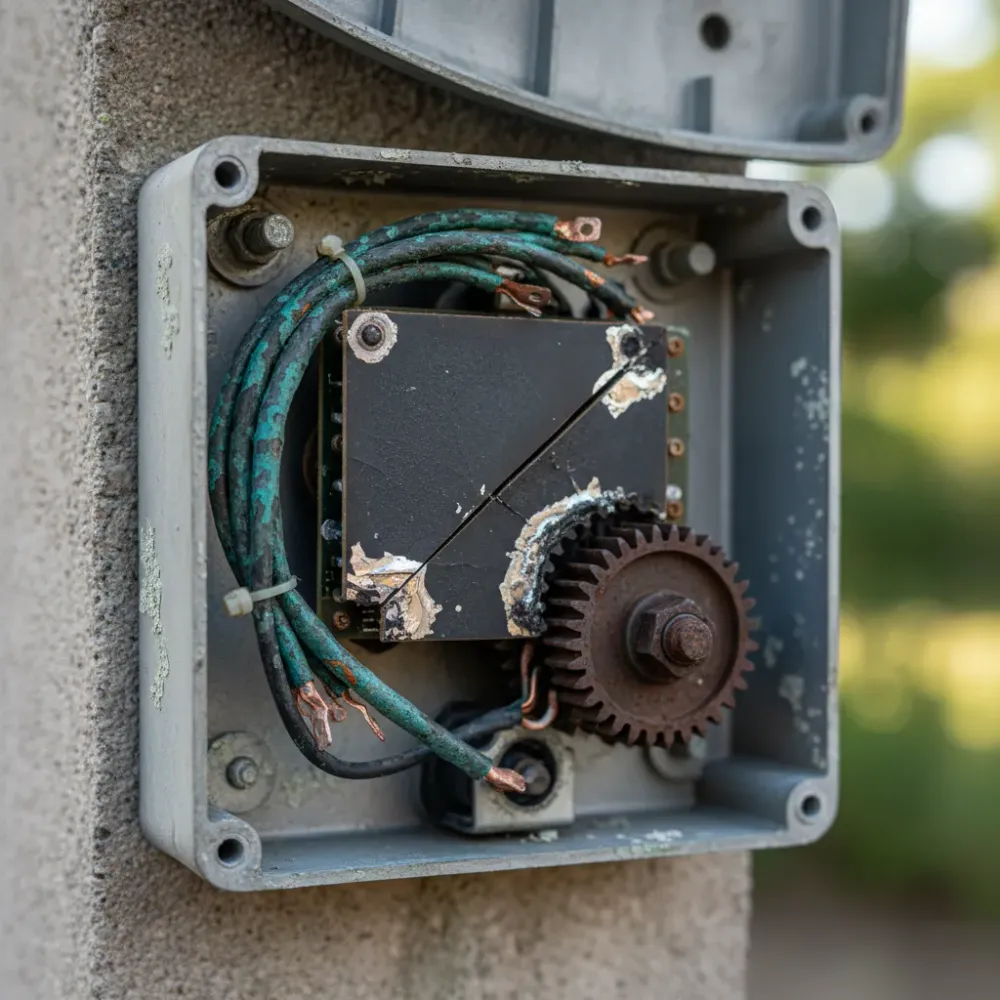
- An electrical problem is occurring. It may be corroded wiring, a tripped breaker, or a short circuit. Coastal air and salt air can eat away at gate controls over time. We opened up control boxes near Golden Isles and green corrosion was on every connector.
An issue that may come as a surprise to many homeowners is that the limit switches inside the gate operator can move out of position. These small switches let the motor operator know where to stop when opening and closing the gate. If these switches move out of alignment, you could open your gate halfway, and it may stop working completely. Or, close your gate and it will reverse back to an open position without any reason you can determine.
Weather and Wear Unique to Coastal Properties
Living close to the ocean can be great. However, your electric gate will feel the effects. In a coastal area, salt air can corrode metal parts in the gate system faster. Dampness causes rust in gate tracks and hinges. A heavy rain event or monsoonal downpour will be enough to flood the gate’s control box if it’s not sealed properly.
Most people don’t realize how vulnerable their gate is until it’s too late.
There are instances where we’ve seen electric gates located just a few blocks from the ocean need track cleaning at a much higher rate than a gate that is on the west side near US-1. The salt buildup will result in increased friction on the gate track. The motor will begin to work extra hard to push the gate open and closed. A broken down motor or part failure is the natural consequence of this type of neglect. A gate motor that was intended to have a 10-year lifespan may begin experiencing problems at 5 or 6 years old.
Age and Lack of Maintenance
A gate motor is an electric motor with multiple moving parts. Rollers, chains, gears, circuit boards are all components that have expiration dates. Without annual service, the cracks widen, and a minor issue today is an issue you can’t open your gate tomorrow. Consider this: Would you drive your vehicle three years without an oil change? The same concept applies to your gate motor.
A common situation involves a condo complex nearby the Diplomat Parkway calling their gate repair service for a gate that halted in the middle of opening during the morning traffic period. Upon closer inspection, the gate repair person finds that the chain had been loose the entire time for a number of months — a little adjustment could have easily stopped this from happening.
When you notice your gate starting to slow down, making loud noises, or when you notice it pausing for a moment before the start of its action, then it is a good idea to seek professional attention because these are the red flags that should not be ignored.
What to Check Before Calling a Technician
Before you pick up the phone, take a look around, but always put yourself first. Gates are heavy; some models are as heavy as a car. Check the following steps:
- Change the remote keypad batteries. This may seem too basic, but most of the time, this may be the main cause. Try using new batteries.
- Check the power supply. Make sure the motor is plugged in and the circuit breaker is set. Visit the main breaker box and check on that first.
- Look at the track and swing path. It’s possible that leaves, stones, toys, tree branches, or other objects are blocking the gate. Check to make sure nothing is in the way of the gate.
- Check the manual release. Every gate motor should have a way to manually open the gate. Look for a lever or key that’s attached to the main unit.
- Inspect the sensors. These small devices are located at the bottom of the gate on either side. Just take a dry rag, clean them, and make sure they are aimed directly at each other.
- Observe motor noise. When you turn on your system with the gate motor and remote, listen for specific sounds. You might hear a hum, a click, or nothing at all. Silence often suggests a fault with the power supply or the control board.
The six-step procedure described above can address around 70% of the “stuck electric gate” service calls handled in Hallandale Beach. Many homeowners jump directly to step six, when the answer is often as simple as a step one or two answer.
Should you employ the manual release, always remember to engage it again prior to activating the motor. It’s a mistake we see over and over: a homeowner opens the gate, releases the motor, then never reconnects it, leading to a gate that just doesn’t move at all.
After going through steps one to six, if the gate still refuses to move or operate, the issue is probably with the gate motor itself, the control board, or even the wiring. Tampering with electrical parts without a strong understanding of what you’re doing is simply unsafe, and in many Hallandale Beach communities with HOA-owned gates, you can cause yourself a liability headache by trying to perform gate repairs without permission.
What A Stuck Gate Typically Indicates About The Motor And Control Board
One piece of advice we can give on the matter: you should understand that the gate in itself is usually not the source of the problem when your gate becomes stuck open or stuck closed.
Rather, the cause often lies with the motor or control board inside the gate motor enclosure. The motor is what’s doing the hard work for the electric gate. The control board tells it what to do. The two components work in tandem and a failure in either can lead to a non-operational gate.
The Gate Motor Problems Most Frequently Responsible For Stuck Electric Gates
A gate motor is a hard-working machine. In Hallandale Beach, it performs in hot, humid weather all year-round, with the coastal location accelerating the corrosion of its inner parts by salt in the air. Homeowners near Golden Isles and A1A call about it all the time. The following are motor issues commonly seen to cause a stuck gate:
- Dead capacitors, which stop the motor from cycling
- Worn out gears within the gearbox that spin the motor but cannot move the gate
- Seized motor bearings, from water exposure and a lack of lubrication
- Overheated motor windings due to the gate motor trying to force open a gate that is out of track alignment
When you press your remote control to open or close the gate, you might hear a humming noise. The noise means that the motor is receiving power but won’t turn over. Or you might hear nothing at all; if that’s the case, the motor has likely failed entirely.
A motor that runs too long will overheat. Most come equipped with a thermal overload switch designed to shut everything off to guard against fire. In that case, your gate’s stuck, and you’re not sure what went wrong.
Control Board Failures
The control board instructs the motor when to open, when to close, and when to stop. It also communicates with your safety sensors, keypads and remote receivers. A single malfunctioning relay on the control board can lock up the entire system.
We’ve retrieved control boards from gate operators in Hallandale Beach that appeared perfect from the outside. Yet flip it upside down and you’ll see burnt circuit board traces. Voltage spikes cause this. The National Weather Service reports the area has an average of 70 to 80 storm days every year.
Other times, a board simply forgets what it’s supposed to do. The gate “loses” its open and closed settings. It attempts to pass the limits, encounters resistance, and the board’s safety mechanism stops it. Or sometimes, ants form a nest in the control box and bridge connections, shorting the whole thing out.
How to Narrow It Down Before Calling
- Listen when you hit the remote. If there’s a hum coming from the operator, it’s probably your motor. If the gate doesn’t move and you don’t hear anything, it’s probably your control board or power supply.
- Check the control box for lights. Most boards have LEDs that flash warning/error codes.
- Check your circuit breaker to make sure nothing was tripped. If your breaker tripped, the problem may have been too much current drawn by the motor.
- Try the wall button if the remote fails. If the wall button works but your remote doesn’t, the problem is likely in the receiver portion of the control board — not the motor itself.
Diagnosing a stuck electric gate can be tricky without the proper tools. We have seen homeowners replace a good motor when the problem ended up being a simple $30 relay on the control board. If you’re stumped as to what’s going on, our electric gate repair specialists can diagnose the issue before any parts are ordered.
Motor and board failure is usually not an either/or occurrence. They can happen gradually in response to months worth of small issues that you may have overlooked — a gate that hesitates in its path, a remote that requires several button presses, the sound of the motor growing louder. All these are warning signs worth acting on.
Frequently Asked Questions
Common questions about electric gate stuck open or closed? here’s why and how to fix it services in 301 NE 3rd St. unit 206 33009 Hallandale Beach
Why does my electric gate in Hallandale Beach keep stopping halfway?
Your gate is likely stopping halfway because the limit switches inside the motor are out of position. These small switches tell the motor when to stop opening or closing. They can shift over time, especially in Hallandale Beach’s heat and humidity. A loose chain or debris in the track can also cause this. If your gate hesitates, slows down, or stops mid-cycle, it’s time to get it looked at before the problem gets worse.
Can salt air really damage my electric gate?
Yes, salt air is one of the biggest threats to electric gates near the coast. In Hallandale Beach, properties close to the ocean see faster corrosion on metal parts, tracks, and wiring. Gates just a few blocks from the water may need track cleaning far more often than gates near US-1. Salt buildup increases friction, which makes your motor work harder. Over time, this can cut a motor’s lifespan nearly in half.
When should I call a professional instead of fixing my electric gate myself?
Call a professional any time the problem goes beyond changing batteries or clearing debris from the path. Electric gates are very heavy — some weigh as much as a car. Trying to push one open by hand can injure you or damage the track. If your gate has a wiring issue, a burned-out motor, or corroded connections, a trained technician is the right call. Our electric gate repair page covers what to expect when you schedule service.
Is it true that dead batteries are a common reason electric gates stop working?
Yes, and it surprises a lot of people. Dead or weak batteries in the remote or the gate’s backup power system are one of the most common causes of a stuck gate. Backup batteries should be replaced every few years. Before calling anyone, try fresh batteries in your remote. It sounds too simple, but it solves the problem more often than you’d think.
What is a photo-eye sensor and why would it keep my gate stuck open?
A photo-eye sensor is a small safety device that detects objects in the gate’s path. If it senses something blocking the gate, it stops the gate from closing so no one gets hurt. If the sensor is dirty or slightly out of alignment, it may think something is in the way even when nothing is there. This keeps your gate stuck open. Cleaning or realigning the sensor often fixes the problem quickly.
How does Hallandale Beach’s summer heat affect electric gate motors?
The intense summer heat in Hallandale Beach can cause gate motors to overheat, especially on properties with little shade. The Door and Access Systems Manufacturers Association notes that extreme heat and humidity are major factors in motor failure for coastal properties. A motor meant to last 10 years may start breaking down at 5 or 6 years without proper maintenance. Scheduling annual service helps catch heat-related wear before it causes a full breakdown.
Ready to Get Started?
Call now for a free estimate — Call (954) 329-1361 today.
