
Fast, reliable garage door and electric gate repair and installation in South Florida — call today, fixed today.
What's Covered on This Page
- How Solar Gate Openers Work in Hot, Sunny Climates
- Sizing the Right Solar System for Your Gate
- When Solar Is Not the Right Choice
- What Happens During a Solar Gate Opener Installation
- Permits and HOA Rules for Gate Automation in Hallandale Beach
- What happens during a solar gate opener installation visit in Hallandale Beach?
- Can tree shade stop my solar gate opener from working in Hallandale Beach?
- Will my solar gate opener still work during a power outage or hurricane?
- How do I know what size solar gate opener system I need?
- How much sun does a solar gate opener need to stay charged?
How Solar Gate Openers Work in Hot, Sunny Climates
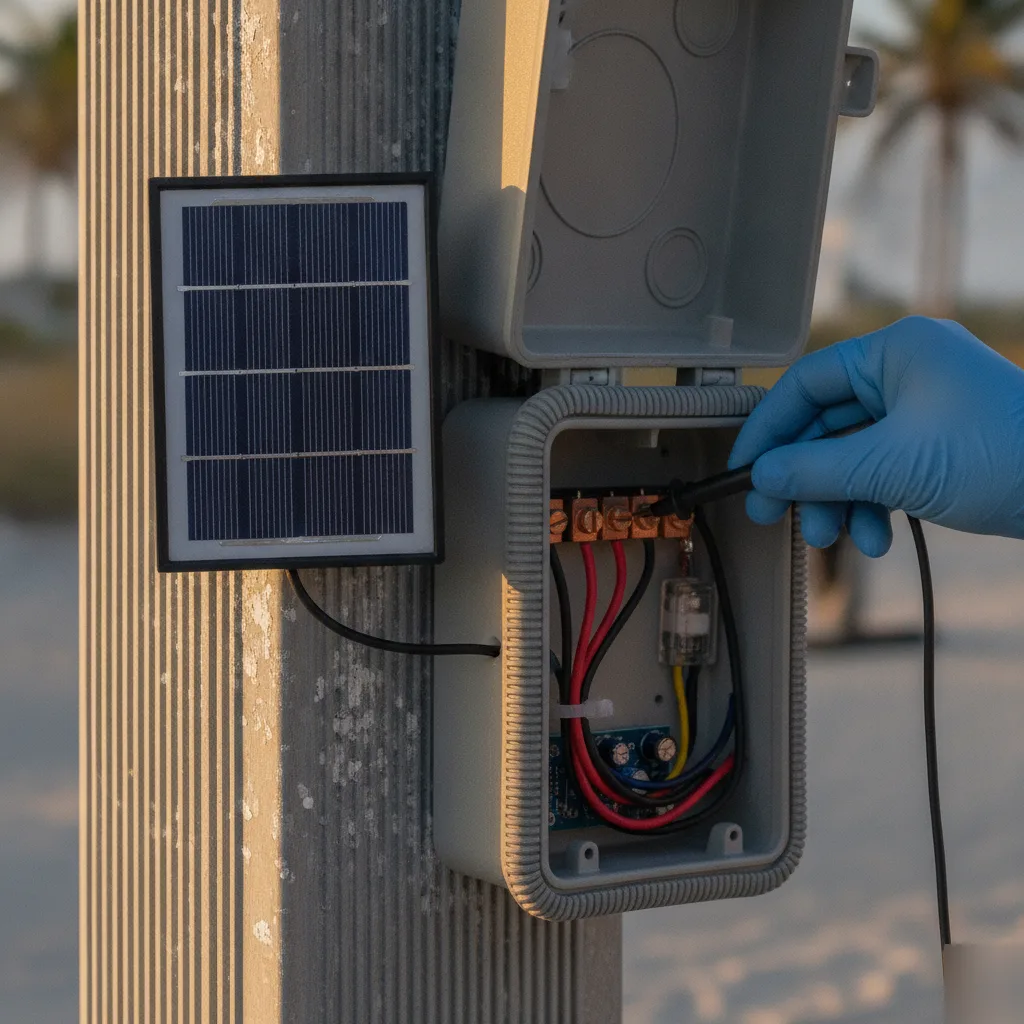
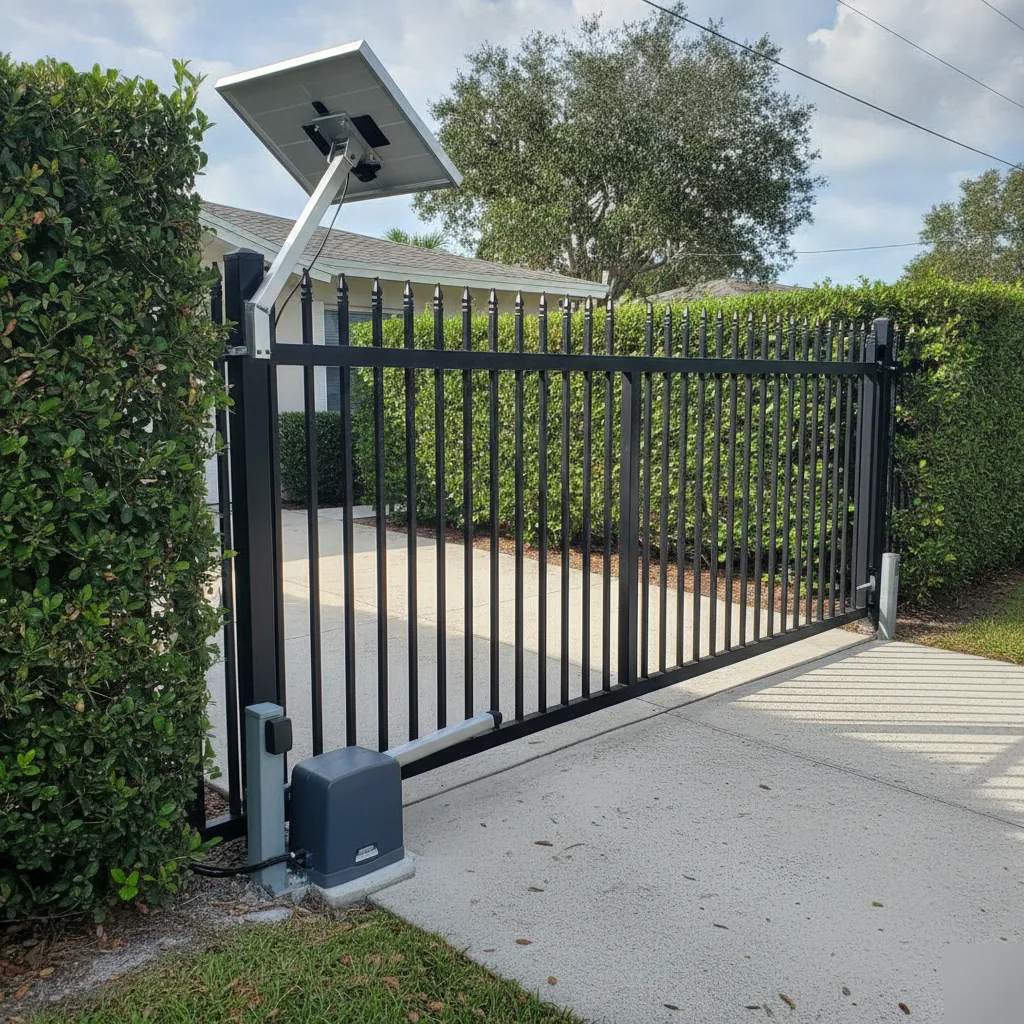
The setup is simpler than most people expect. A solar panel, usually mounted on a post or the gate column, collects sunlight and converts it into electricity. That electricity flows into a deep-cycle battery stored inside the opener unit. Every time someone triggers the gate with a remote, keypad, or phone, the motor draws from that battery. The panel recharges it throughout the day.
Does it hold up in South Florida heat? Yes. The concern we hear most is about the battery overheating or the panel degrading. Modern solar gate opener systems are built for this kind of environment. The panels are tempered glass rated for UV exposure. The batteries are sealed and heat-tolerant. Hallandale Beach sits right along the coast where direct sun is abundant almost year-round. That's the biggest factor in reliable solar performance.
Here's what surprises people. Even on overcast days the panel generates enough charge to keep the battery functional. A fully charged battery can run a residential gate through 30 to 50 cycles without any new solar input. For most homes along Three Islands Boulevard or in the Golden Isles area, that's several days of normal use.
There's no trenching for electrical wire. The install doesn't tear up your driveway or landscaping. That matters a lot in older Hallandale Beach neighborhoods where driveways are narrow and utility access can be tricky. You skip the electrician and the permit headaches that come with running new conduit. You just mount the panel and wire it to the opener.
The real advantage is independence from the grid. When a summer storm knocks out power for a few hours, your gate still opens and closes. Every hurricane season, properties with hardwired openers get stuck while solar-powered gates keep running. That peace of mind is worth more than any feature on a spec sheet.
Solar gate openers aren't magic. They need the panel positioned where it gets direct sunlight for at least four to five hours a day. Heavy tree canopy or a north-facing column can reduce output. We check all of that before recommending a solar system for your property.
Sizing the Right Solar System for Your Gate
Not every solar gate opener setup is the same size. A 10-watt panel that works fine on a lightweight pedestrian gate won't work for a 600-pound wrought iron driveway gate. Getting the sizing wrong is the fastest way to end up with a gate that stops halfway open on a cloudy afternoon.
Three numbers matter here: panel wattage, battery amp-hours, and daily gate cycles. Think of the panel as income and the battery as savings. The panel charges the battery during daylight. The battery powers the opener every time the gate moves. If your gate opens and closes 30 times a day, you need a bigger battery and a bigger panel than someone whose gate cycles five times.
Most residential driveway gates in Hallandale Beach run on systems between 10 and 50 watts. That range sounds wide, but it narrows fast once you factor in the gate's weight and how often it moves. A single-swing aluminum gate under 300 pounds usually does well with a 10 to 20 watt panel and a 7 amp-hour battery. Dual-swing iron gates or heavy sliding gates almost always need 30 watts or more, paired with a 12 to 18 amp-hour battery. People often assume a small panel will handle a heavy gate just because we get plenty of sun down here.
Hallandale Beach gets great sun. South Florida averages roughly 5.5 peak sun hours per day according to the National Renewable Energy Laboratory. That is a real advantage. A properly sized panel recharges the battery faster than it would in most of the country. Peak sun hours drop during summer storms. We always size for the worst month, not the best one.
Here is what catches people off guard. Shade from a single palm tree can cut panel output by 40 percent or more. Before any solar gate opener installation, we check the mounting location at different times of day. A panel that sits in full sun at noon might be shaded by 3 p.m. That matters. It can mean the difference between a gate that works and one that dies by evening.
The brands we work with, including GTO/Linear, are designed for this kind of setup. The brand only performs as well as the sizing behind it. If you are not sure what your gate weighs or how many cycles it runs per day, that is fine. We can figure it out during a quick site visit. Sizing is not guesswork - it is math. Getting it right means your gate runs every day without you thinking about it.
When Solar Is Not the Right Choice
We would install a solar gate opener on every property we visit if we could. Some gates, driveways, and situations do not work with solar power. Telling you that upfront saves everyone time and money.
Heavy shade is the biggest reason solar might not work. If your gate sits under a dense canopy of mature oaks or sea grapes that block direct sunlight most of the day, a solar panel cannot charge the battery fast enough. South Florida gets plenty of sun, but the panel needs to see it. We have walked properties along some of the older residential streets west of Dixie Highway in Hallandale Beach where large ficus trees cast shade across the entire driveway entrance from about 10 a.m. That is a real problem for solar charging.
Gate weight matters too. Most solar openers are rated for gates up to around 800 to 900 pounds. If you have a heavy wrought-iron double gate or a commercial sliding gate that runs 20 feet or longer, the motor draw on every cycle can drain the battery faster than the panel refills it. In that case, those heavy gates need a hardwired electric gate opener.
High-cycle use is the other consideration. A residential driveway that opens and closes maybe 10 to 15 times a day is perfect for solar. A gated parking entrance at a condo building on Hallandale Beach Boulevard that cycles 80 or 100 times daily is not. The math does not work. The battery cannot keep up with that demand on solar alone.
There is also the panel placement. If the only spot for the panel faces north or sits in a location where nearby buildings block afternoon sun, you will get inconsistent charging. Not every property has a good mounting angle.
If any of this sounds like your situation-a heavy gate, deep shade, or high traffic-a hardwired system is the smarter move. We would rather steer you to the right solution the first time than come back six months later to swap everything out.
Have questions? We're happy to help.
Call Today For A Free Estimate. On Time Garage Door Repair is ready to help.
What Happens During a Solar Gate Opener Installation
Most people picture a huge construction project. It's not. A solar gate opener installation is one of the cleaner jobs we do. It usually wraps up in a single visit. Here's what happens from start to finish.
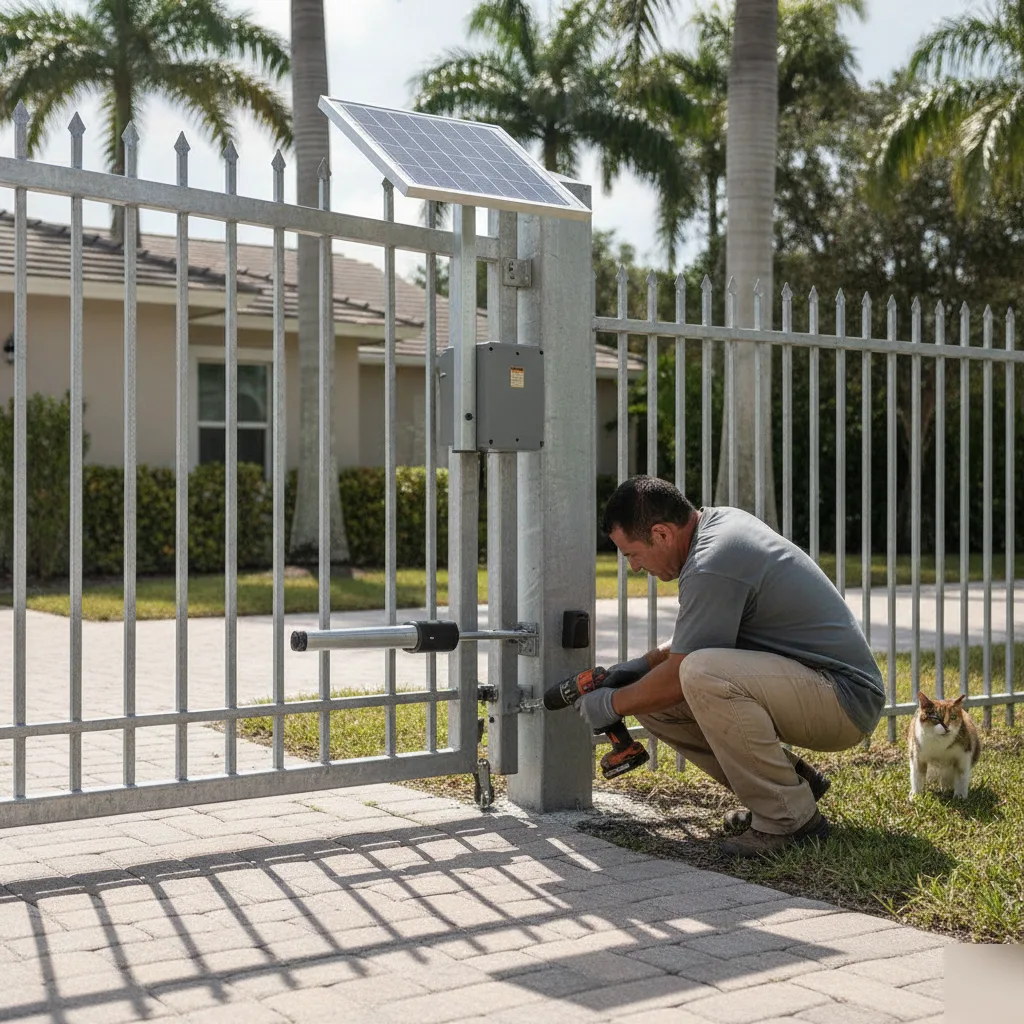
We start with a site look. We check your gate, your driveway layout, and the direction your property faces. In Hallandale Beach, most residential lots along streets like SE 1st Avenue and near Golden Isles have south or southwest exposure. This is ideal for solar panel placement. We check that nothing blocks sunlight for most of the day: trees, awnings, or second-story overhangs. Then the panel gets mounted right on the gate post or a nearby fence rail.
After the site check, the process moves fast.
- We mount the solar panel in the spot with the best daily sun exposure and run the wiring to the battery box.
- The battery pack gets installed in a weatherproof enclosure, usually at the base of the gate post or on a concrete pad nearby.
- We attach the gate motor to the gate itself, whether it's a swing arm unit or a sliding track operator. We connect it to the battery system.
- The control board goes in next. This is the brain. It handles open and close cycles, auto-reverse safety sensors, and remote access.
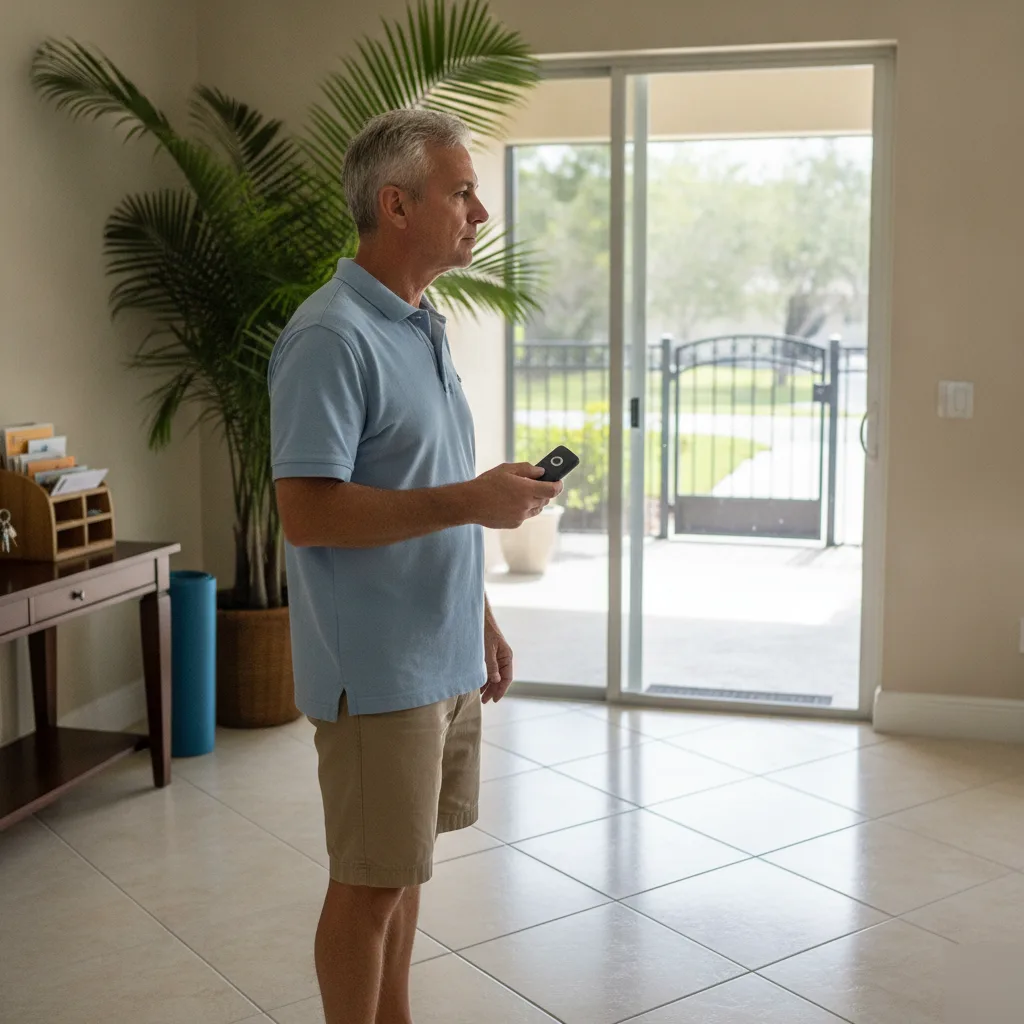
- We program your remotes, keypads, or any smart access features. We test every cycle multiple times.
- The final step is a full safety check. We verify the auto-reverse triggers correctly, confirm the gate clears its path, and make sure the battery holds a proper charge.
There is no trenching for electrical lines. There are no permits for high-voltage conduit. South Florida's building stock leans heavily toward concrete block and stucco with metal or aluminum gates. Solar openers bolt right onto those setups without tearing anything apart.
We always double-check battery capacity relative to gate weight. A heavy wrought iron gate needs a bigger motor and a larger battery bank than a lightweight aluminum panel gate. We size the system to your gate, not the other way around. Hallandale Beach gets an average of 248 sunny days per year. The solar panel keeps that battery charged with very little effort on your part.
Here's what surprises people most - the gate works even on cloudy days and at night. The solar panel charges the battery during daylight. The battery runs the gate around the clock. You're never stuck outside waiting for sun.
Permits and HOA Rules for Gate Automation in Hallandale Beach
Many people don't think about permits until they're halfway through a project. That creates problems. In Hallandale Beach, any new gate motor or automated gate system usually requires a building permit through the City's Building Division. The permit process confirms your installation meets local electrical and structural codes. Skip it, and you could face fines or be forced to remove the system.
Hallandale Beach has many condos, townhome communities, and gated developments along corridors like East Hallandale Beach Boulevard and near the Diplomat area. Almost every one of those communities has an HOA with its own rules about exterior modifications. A solar gate opener installation counts as an exterior modification. Even after you pull a city permit, your HOA board may need to approve the equipment placement, panel visibility, and gate style before any work begins.
This situation comes up often. A homeowner orders equipment, then finds their HOA requires an architectural review that takes 30 days. The equipment then sits in a box in the garage.
The smart move is to handle both tracks at the same time. Start your HOA application the same week you request your city permit. That way neither process holds up the other. If your property isn't in an HOA, you still need the city permit.
Here are a few things to sort out before you schedule your installation:
- Check with the Hallandale Beach Building Division on current permit fees and inspection requirements for gate automation.
- Request your HOA's architectural guidelines and find out their review timeline.
- Confirm whether your property's electrical panel can support the system or if a solar-only setup avoids additional electrical permits.
- Ask your installer if they handle permit applications on your behalf.
Solar-powered systems sometimes simplify the electrical side of permitting because they don't tie into your home's main panel. The structural and mechanical components still need inspection. Don't assume solar means permit-free - it doesn't.
We handle the coordination so you're not chasing paperwork. If you want to know exactly what your property needs before we show up, just give us a call and we'll walk you through it.
Frequently Asked Questions
Common questions about Solar Gate Opener Installation
What happens during a solar gate opener installation visit in Hallandale Beach?
We start by checking your gate's weight, how many times it cycles per day, and where the sun hits your property. This tells us the right panel wattage and battery size before we mount anything. Since there's no trenching or electrical conduit involved, we skip the permit delays that come with hardwired openers. We mount the panel where it gets four to five hours of direct sun, wire it to the opener, and test the gate through a full cycle before we leave. Most driveway gate installs finish in a single visit.
Can tree shade stop my solar gate opener from working in Hallandale Beach?
Yes, heavy shade is the most common reason a solar gate system underperforms here. We've seen this on older residential streets west of Dixie Highway, where mature ficus trees shade the entire driveway entrance by mid-morning. Even one large palm can cut panel output by 40 percent or more. Before installing, we check your mounting spot at different times of day to catch shifting shade patterns. If your driveway sits under dense canopy, we'll tell you upfront whether solar makes sense for your gate.
Will my solar gate opener still work during a power outage or hurricane?
Yes, that's the main advantage of going solar. Because the system runs off a charged battery instead of your home's electrical panel, it keeps opening and closing your gate even when the grid goes down. Hallandale Beach sees plenty of summer storm outages, and properties with hardwired gate openers often get stuck shut or open during these events. A fully charged battery can handle 30 to 50 cycles with zero new sunlight, which covers most homeowners through a multi-day outage.
How do I know what size solar gate opener system I need?
It comes down to your gate's weight and how many times it opens and closes each day, not guesswork. A light single-swing aluminum gate under 300 pounds typically needs only a 10 to 20 watt panel and a small battery. Heavier dual-swing iron gates or sliding gates usually need 30 watts or more with a larger battery. If you don't know your gate's exact weight or daily cycle count, we figure that out during a quick site visit before recommending a system.
How much sun does a solar gate opener need to stay charged?
It needs at least four to five hours of direct sunlight on the panel each day to keep the battery reliably charged. Hallandale Beach averages roughly 5.5 peak sun hours daily, which gives most properties more than enough exposure when the panel is mounted correctly. Even on cloudy or overcast days, a well-placed panel still generates enough charge to keep the gate running. The key is panel placement, not just how sunny the city is overall.
Ready to Get Started?
Call 9548334351 Today For A Free Estimate.
