
Fast, reliable garage door and electric gate repair and installation in South Florida — call today, fixed today.
What's Covered on This Page
- Signs Your Gate Motor Is the Real Problem
- How Salt Air and South Florida Heat Wear Down Gate Motors Faster
- The Gate Motor Repair Service Process
- After Repair: Remote Programming and Safety Checks
- How do I know if my gate motor needs repair or just a simple fix?
- How does Hallandale Beach's salt air affect gate motors?
- How quickly can a technician get to my property in Hallandale Beach?
- What should I expect when the technician arrives for a gate motor repair?
- Can moisture from South Florida rain get inside the motor and cause damage?
- When does it make more sense to replace the motor instead of repairing it?
Signs Your Gate Motor Is the Real Problem
Your gate stopped working. But is it the motor, or something else entirely?
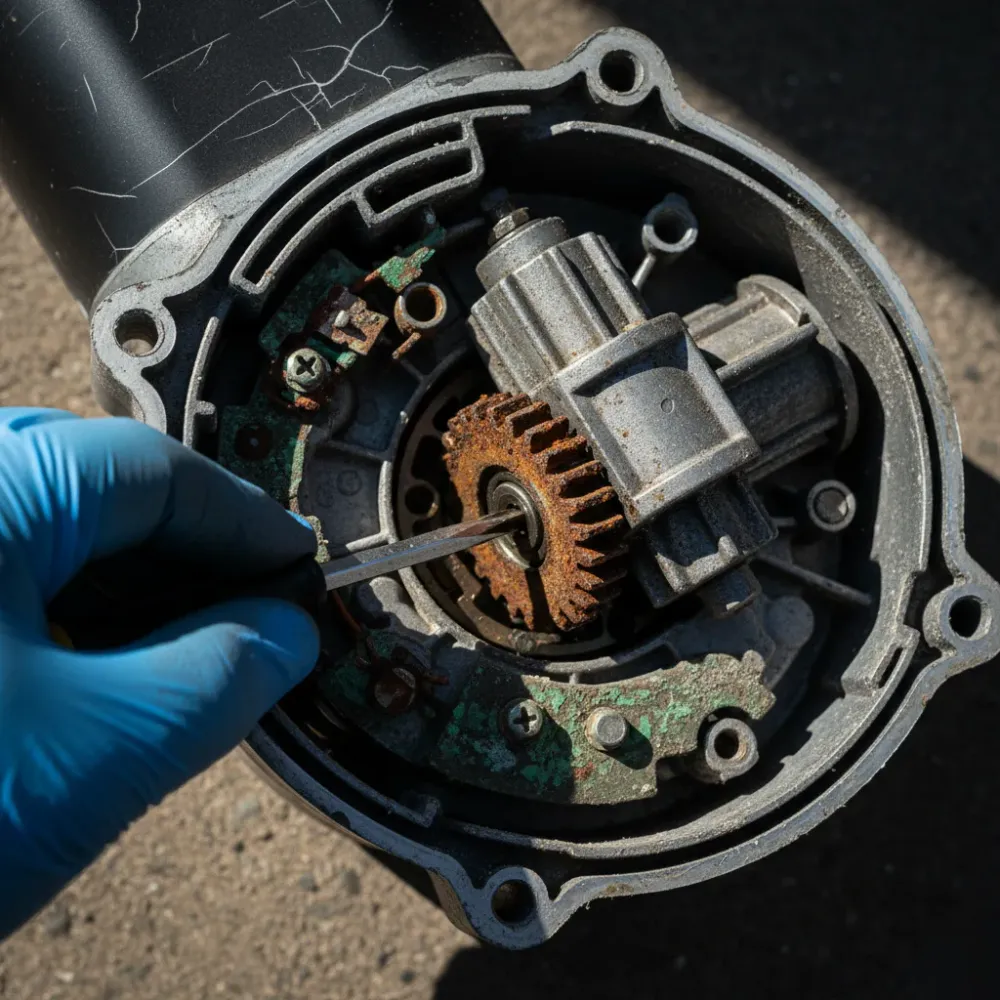
We get calls every day in Hallandale Beach from folks who assume the worst. Sometimes it's just a dead remote battery or a sensor that got bumped. But when the motor itself is failing, there are specific things you'll notice that point straight to it. After years of handling gate motor repair service calls across this area, we've learned to read the signs fast.
Here's what tells us the motor is the real issue:
- A grinding or humming sound when you press the button, but the gate barely moves or doesn't move at all
- The gate opens halfway then stops, reverses, or just quits mid-cycle
- Burning smell near the motor housing, which usually means the windings are overheating
- The gate moves painfully slow compared to how it used to operate
- You hear a click from the control board but nothing happens at the motor
That humming sound is the one we see most often. it means the motor is drawing power but can't convert it into movement. Could be worn gears inside, could be a seized bearing. Either way, the motor needs hands on it.
Here's a scenario we run into a lot near the Golden Isles neighborhood. A homeowner's sliding gate starts dragging one morning after a heavy rain. They figure the track is dirty, they clean it out, but the gate still struggles. What actually happened is moisture got into the motor housing and corroded the internal components. The track was fine the whole time.
And sometimes the signs are subtle. Your gate takes two or three extra seconds to respond. You might ignore that for weeks. But that delay usually means the motor capacitor is weakening, it won't get better on its own. Catching it early saves you from getting locked out at the worst possible moment.
Not sure if what you're dealing with is the motor or something else? That's actually pretty common. We can usually tell within the first few minutes of looking at it.
How Salt Air and South Florida Heat Wear Down Gate Motors Faster
Living a few blocks from the ocean sounds great until you see what it does to metal parts.
Gate motors in Hallandale Beach take a beating that most inland systems never face. The salt air corrodes wiring terminals, eats through exposed connectors, and leaves a crusty film on circuit boards. We pull open motor housings near the Diplomat area and find green corrosion caked on contact points that were clean six months ago. That's not normal wear.
It’s the ocean working exactly the way it should. Then you throw in the heat. South Florida summer sun can heat up the black motor housing past 140F and make a capacitor swell and the lubricant evaporate much faster than any spec sheet would’ve predicted. Thermal shock, hot all day and then an occasional afternoon thunderstorm, is another big cause of solder joint failures over time. We see this weekly with three- or four-year-old motors.
Basically, what this all adds up to is: Corroded relay contacts cause the motor to pause or not accept remote instructions, dried-out gear grease causes the motor to work harder, draw more amps, and trip the breaker, weakened (swollen) capacitors provide less starting torque and the gate opens more slowly or gets stuck halfway, salt build up on sensors causes a failure by making the safety system think an obstruction is detected. It’s all the same. Someone calls saying, “My gate just stopped opening,” but a small thing happened months ago and the problem started small. A hesitation, or a strange sound. By the time the gate isn’t opening at all, there may be more than just one issue needing attention.
This may affect properties along A1A the most, but nobody here in Hallandale Beach is really safe from it. A home one mile from the water will still suffer from salty humidity that permeates every corner of the property. According to the Federal Highway Administration, salt-rich air increases corrosion rates compared to inland conditions. A gate motor is exposed 24/7. That’s why early attention is.
Repair vs. Replace, How We Tell the Difference
Of course, a gate motor can be repaired. This is the simple truth. However, in certain cases, repair only serves as a delay. When do we recommend repair vs. replacement? This usually depends on the following factors that we look at on every job in Hallandale Beach: the age of the motor, type of failure, and how many times this motor was serviced last year. You know the old saying that if you have to fix something 3 times within a year, it should be replaced? Well, there’s something to that.
When to Repair
Most gate motor issues can be resolved with a simple fix. A dead capacitor, stripped gears, or a board that was fried by a storm. These things can be replaced the same day we see the problem. We're always seeing this around Golden Isles, where salt air is corroding wires or terminals but the motor itself is fine. If a motor is mechanically fine and the problem is electrical or mechanical on the outside, repair is the move.
What suggests repair:
- Motor is buzzing but not moving the gate
- One part is bad, the rest checks out fine
- The unit is less than five years old and has never given us any issues.
- Weather or rodent damage to the wiring was the culprit.
Those problems have easy fixes.
When Replacement Is a Better Solution
Then there are times we get a call where we open the motor housing and know immediately. The internal bearings are worn to dust. We see rust corroding the unit's interior, as they do when exposed to South Florida's humidity for so many years. It's pulling high amps and runs hot on every cycle, that's just another motor running on borrowed time.
Also, in some cases we will recommend a replacement motor when a motor model is no longer manufactured and parts are discontinued. Attempting to find parts for a now-defunct motor is a waste of your money. We'd rather tell you that now and then not charge you for a repair job that won't make it through the summer.
Our repair team has repair parts and replacement motors with them on our service trucks in Hallandale Beach. So, no matter what the issue is, we can usually take care of everything during one service visit. No need to schedule a second visit. No having to wait for a week for your gate to work.
Not sure which route your issue requires? Give us a call. We'd be happy to walk you through it.
The Gate Motor Repair Service Process
You called. We showed up. What's next?
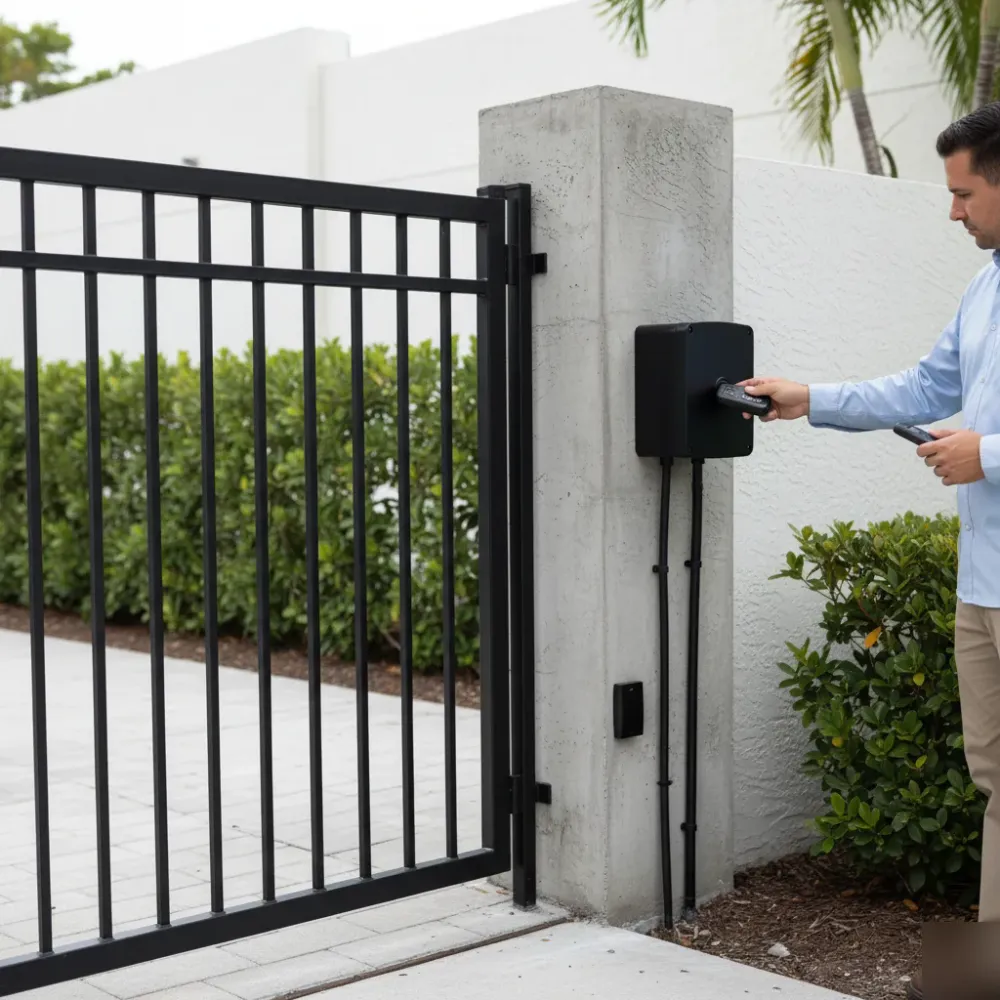
Here's a step-by-step look at what happens during our gate motor repair service visit after we've arrived at your Hallandale Beach gate. There's no guesswork, no surprises.
- Visual inspection and physical examination of the entire system. We'll inspect the motor housing, wiring harnesses, control board, and mounting bracket for problems. We'll look for frayed wires, corroded connectors, loose mounting bolts, and cracked gears. The air close to the Intracoastal carries a lot of salt and corrodes components very quickly.
- Electrical testing of the system. We test voltage to the motor, voltage to the control board via the transformer, and voltage to the control board relay. When voltage reaches the motor and nothing happens, we're dealing with a motor issue. When voltage fails to make it to the motor, we have an issue that isn't the motor.
- Mechanical testing of the gate. We'll manually force the gate to check for resistance. When a gate is stuck or the tracks aren't aligned properly, it's not difficult for a motor to burn out from having to force the gate open.
- Our diagnosis and your explanation. Once we're done testing, we explain to you in plain English exactly what happened. We'll point out the problem if there is a visible failed part. You'll know exactly what needs to be done before we pick up our tools and start repair work.
- Repair and recalibration. We'll install a replacement motor (or whatever component failed), and then set the travel limit switches, auto-close timer, and sensitivity level for the safety sensors. Every single setting on the controller needs to be tuned correctly to have the gate open and close smoothly and safely.
- A full cycle system test. We'll manually operate the gate using each individual control method multiple times. We'll also test the keypad and security sensors. We don't take anything for granted; everything needs to work correctly once we're finished.
Most of our repairs can be done in two hours or less. In fact, we always finish our work the same day we do your service appointment. Common components are stocked on our truck; we don't want you having to wait a couple days for a gate motor part. When we do spot an issue outside of the motor, damaged tracks, a malfunctioning control board, we'll be sure to let you know in the field. Because we provide electric gate repair, sliding gate repair, and swing gate repair services, we don't expect you to call anyone else. The point of this process is that you observe our work, learn about what is causing the problem, and see your gate operational before we leave.
Need help with gate motor repair service?
Call Today For A Free Estimate. On Time Garage Door Repair is ready to help.