
Fast, reliable garage door and electric gate repair and installation in South Florida — call today, fixed today.
What's Covered on This Page
- Warning Signs Your Extension Springs Are Failing
- Why Do Extension Springs in Older Homes Break Early?
- How do I know if my extension springs are the problem and not something else?
- Why do extension springs in Hallandale Beach homes seem to fail faster than expected?
- Is it really necessary to replace both extension springs at the same time?
- What is a safety cable, and does my Hallandale Beach garage door have one?
- What happens if I keep using my garage door after a spring starts failing?
- How long does an extension spring replacement appointment typically take in Hallandale Beach?
Need garage door extension spring replacement service?
Call Today For A Free Estimate. Call On Time Garage Door Repair now.
Warning Signs Your Extension Springs Are Failing
Sometimes you hear it before you see it. A loud boom from the garage, sounding like you just dropped a heavy object. That’s likely a spring snapping. More often than not though, extension springs don’t go bad in an instant, they show you the warning signs of impending failure for weeks before they actually fail.
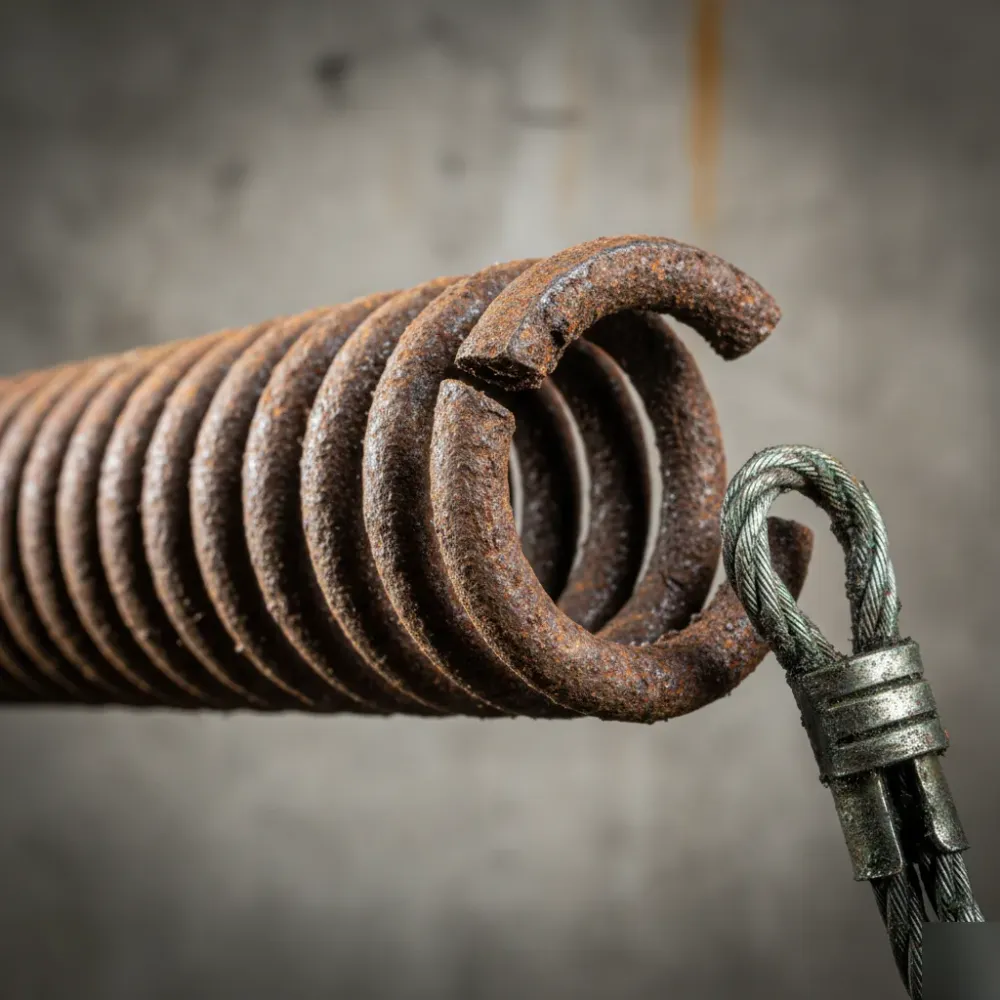
We see this every week in Hallandale Beach. A homeowner reaches out to us because their garage door “feels heavy” or “looks crooked.” These are common warning signs:
- The door jerks or stalls when it first starts to open
- One side of the door hangs lower than the other
- You notice visible gaps, missing coils, or stretched springs
- The opener strains and works harder than before
- The door closes much faster than usual.
The last one on that list is a major red flag. The reason why is that the garage door spring is not doing its job, and the garage door opener is forced to do everything, even lift the whole door. If left unfixed that will burn out the garage opener fast.
Another thing you might not have thought of is that extension springs are always used in pairs. When one spring breaks or is worn, the other spring is taking extra load. When we tell homeowners in the Golden Isles to replace their springs it is usually recommended that they replace both springs because if one spring is broken, the other spring will be damaged very soon.
Confused as to what is wrong with your garage door? That is a normal reaction. You might have other garage door problems like cables, springs or rollers. However, we have one simple way for you to determine if your extension springs are bad. Disengage your opener and try to open your garage door manually. It you have to do an arm-bust lifting dead-lift then your springs are bad.
Do not leave it. The more you let a bad spring go it will cause stress to the cables, tracks, hinges and so on. What may start as a simple garage door spring repair can turn into a big job if you allow it to go too long. We go to a home where we see a broken garage door spring that has broken off the cable, which has come off the drum, causing the door to come off the track, everything. And that problem could have been fixed two weeks earlier with a simple garage door spring replacement.
Finally, if your garage door will not open at all, then that is definitely a problem. You’ve passed the warning stage.
Why Do Extension Springs in Older Homes Break Early?
Many garage door calls we get in Hallandale Beach are for houses built in the 70s and 80s. These doors and the garage door springs they came with were made to last, but that doesn’t mean they last forever.
Extension springs are rated by cycles. A cycle is an opening and closing of the door. The average cycle count on a garage door spring is about 10,000. That is a lot of cycles until you realize that if you open your garage door 4 times each day, you reach the limit of your garage door spring in under 7 years. Fifteen, even twenty years, have passed since the springs on many Golden Isles homes last saw change. It’s a bit tricky when you’re replacing springs on older doors:
- Original springs were often thinner gauge steel with lower cycle ratings than what's available now
- Decades of salt air exposure in South Florida corrodes metal faster than inland climates
- Older tracks and hardware create more friction, forcing springs to work harder every single cycle
- Many systems were never lubricated or inspected after the initial install
We see it constantly: Someone hears a loud bang out from the garage. Walks out and the door is sitting crooked, or doesn’t move at all. The spring broke and the safety cable caught it (lucky you); now the door won’t open. The spring should have been changed years ago. And here’s where it gets worse. Many older homes around Hallandale Beach still have single-car garage doors, so it seems lighter and maybe nothing can really happen. But lighter doors still require springs, which are often just smaller diameter springs. And smaller springs get stretched closer to the upper limit of their capacity each time the door opens and closes. They wear out faster. Corrosion is a huge problem down here. You can look at a garage door extension spring and the corrosion isn’t always visible on the surface of the spring. The coils can develop microfractures from salt exposure long before any deterioration is visible. You’ll have a broken spring before you know anything is wrong. If you haven’t had the garage door springs inspected and adjusted in over ten years, you are due now. Don’t wait for the bang.
The Safety Cable System and Why It Must Be Inspected
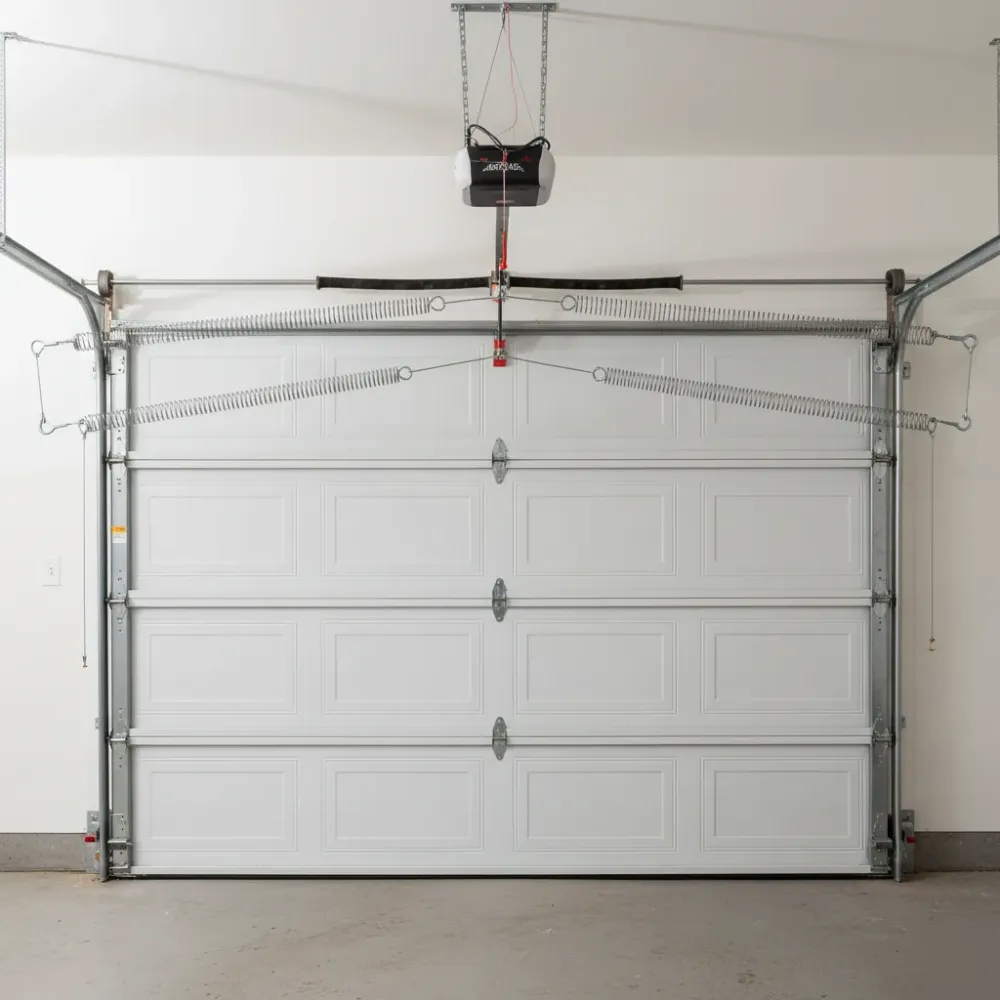
You probably have no idea there even is a safety cable in your door. It’s a steel cable that runs through the middle of the extension spring and acts to hold the spring together in the event of a spring break. Without it, a broken spring becomes a projectile in your garage. We’ve come to homes near Three Islands without the safety cable at all. The person who put the door and the springs in didn’t install the safety cables. It’s not a cost saving, it’s a major hazard that is putting your family and your car at risk. Here is what we check on extension springs:
- Do we have a safety cable installed on both springs?
- Are the cables free from damage (frays, kinks, rust)?
- Is the safety cable routed through the extension springs properly?
- Is the cable routed and tensioned correctly?
A loose safety cable is nearly as bad as a missing cable at all. You want the safety cable to be installed properly so that if the spring fails, the cable can actually contain the spring. We have seen loose safety cables before. So if the extension springs are old enough that they need to be replaced, so should the safety cables. They exist under high tension in humid South Florida conditions. They corrode slowly. And if you can see any rust or single broken strand in it, the cable is already done. Per guidelines provided by the International Door Association, safety cables on your door should be replaced at the same time as worn-out extension springs. This is what we do on every single job. So the next time our technicians replace extension springs for you, we don't just replace the spring. We also check the condition of the entire safety cable on the door, replace any if the condition doesn't seem acceptable, and that they are properly attached on both sides of the garage door. With hundreds of cycles that the doors make a year, each one puts additional stress on the cables. Don't risk it by not changing out your cables in Hallandale Beach. If you need help, we're the ones who do garage door extension spring replacement. If you're not sure about the status of your safety cables, contact us.
How Does an Extension Spring Replacement Work?
You've called and now our crew's headed to your door. What do they actually do when they come and are working on your home in Hallandale Beach? What follows are steps in the spring replacement process. It's not a black box. Extension springs can be replaced in the following manner.
- The garage door will be held closed. The door will be held in a fixed position using a clamp, or the garage door's tracks will be secured using a pair of locking pliers, so that the door won't move while the springs are disassembled. This is the most critical safety precaution, because it means that the garage door won't fall on people while the technician is working on it.
- Disconnect the door from the opener. In order to have the garage door work manually, you have to disconnect the door from the automatic opener so there can be no surprises of a remote button being pressed accidentally.
- Remove old springs. After the tension is released from the springs, they will be unhooked and removed from the track and pulley system. Safety cables should also be removed to be replaced if they are damaged.
- Check everything else while you are here. We will also look at the pulley cables and track brackets while we are there. We will have already spotted worn pulleys or frayed cables if we found those as well. That will save you from having to come back for a second trip.
- New springs and safety cables. The new springs are then hung, hooked on the pulley fork, and connected to the track on the door itself. A fresh set of cables that thread right down the middle of the spring are used as safety cables; should the spring break, these are what keep it from becoming a projectile inside your garage.
- Balance and test. Our guys remove the locking pliers, lift the door and let go halfway. If a balanced door sits where it is, you are set. If it moves up or down from there, we adjust. Once the door is connected to the opener again, we run a bunch of complete open-close cycles to confirm that everything works as intended.
Most often this process takes an hour, but might take a little bit less for a single door near Golden Isles or a bit more for an older doublewide that has not had any maintenance done in years. We also take the time to apply a lubricant to all of the moving components in the system before we leave, even if we are just doing an extension spring replacement. A few techs might just leave it. Rollers, hinges, the spring coils themselves. It cuts down on noise and helps the new springs last longer. But the real point of all this? You shouldn't have to wonder what's happening in your garage. We walk you through every step if you want to watch. Most folks in Hallandale Beach appreciate that kind of straight talk, no clipboard jargon, just showing you what we did and why. Need help figuring this out? Give us a call.
How to Verify Your Garage Door Is Balanced After Spring Replacement
New springs don't mean much if the door isn't balanced right. We check this before we ever leave a job in Hallandale Beach, and, it's one of the most important steps in the whole process. A balanced door sits where you put it. That's the simple test. But there's a specific way to verify it, and you can do this yourself anytime after the work is done.
Disconnect the garage door opener by pulling the emergency release cord. Lift the door by hand to about waist height, roughly three to four feet off the ground. Let go. The door should stay put. Not drift up. Not slide down. If it drops more than a couple inches, the spring tension is too loose. If it shoots upward, the tension is too tight.
Either problem means the extension springs need adjusting. We see this with DIY jobs more than anything else, the springs get swapped out but nobody fine-tunes the tension afterward. That's a mistake that causes premature wear on your cables, rollers, and opener motor. There's another thing most people miss. Watch the door as it travels. It should move smoothly without jerking or hesitating at any point along the track. A door that stutters halfway up usually has uneven spring tension on one side. Over near Golden Isles, we worked on a two-car garage where the homeowner replaced one spring but not the other. The door looked fine sitting closed, it pulled hard to the left every time it opened. And listen to it. A properly balanced door is quiet. Grinding, popping, or squealing after a spring replacement tells you something isn't seated correctly. We always run the door through three or four full cycles before we pack up. Open, close, open, close. If anything feels off on cycle three that didn't show up on cycle one, we catch it right there. According to the International Door Association, an unbalanced garage door puts up to 50% more strain on the opener system. That shortens the life of parts you just paid to fix. Bottom line: if your door won't hold still at the halfway point, call us back. That's not normal.
Frequently Asked Questions
Common questions about garage door extension spring replacement service services in 301 NE 3rd St. unit 206 33009 Hallandale Beach
How do I know if my extension springs are the problem and not something else?
The easiest way to tell is to disengage your opener and try lifting the door by hand. If it feels like a dead-lift at the gym, your extension springs are failing. A healthy door should feel light and balanced when lifted manually. If one side hangs lower than the other, or the door jerks when it starts to open, those are also strong signs. Don't guess — this simple test gives you a clear answer fast.
Why do extension springs in Hallandale Beach homes seem to fail faster than expected?
Salt air is the main reason. Hallandale Beach's coastal climate causes metal coils to corrode from the inside out, developing microfractures you can't see on the surface. Springs can look fine and still be weeks away from snapping. Older homes built in the 70s and 80s often still have their original springs, which were rated for around 10,000 cycles — that's less than seven years if you open your door four times a day. Many of those springs are decades overdue for replacement.
Is it really necessary to replace both extension springs at the same time?
Yes, and here's why it matters to you. Extension springs always work in pairs. When one breaks, the other has been carrying extra load and is already worn down. If we only replace the broken spring, the second one usually fails within weeks. Replacing both at the same time saves you a second service call and protects your opener from the strain of an unbalanced door. It's the smarter move every time.
What is a safety cable, and does my Hallandale Beach garage door have one?
A safety cable runs through the center of each extension spring. If a spring snaps, the cable keeps it from flying across your garage like a projectile. Not every door has them — we've arrived at homes near Three Islands where safety cables were never installed at all. When we replace your springs, we check that both cables are present, properly routed, and free from rust or fraying. If they're missing or damaged, we replace them. This is non-negotiable for your family's safety.
What happens if I keep using my garage door after a spring starts failing?
The damage spreads quickly. A weak spring forces your opener to carry the full weight of the door, which burns out the motor faster than you'd expect. It also puts extra stress on cables, tracks, and hinges. We've arrived at jobs that started as a simple spring replacement and turned into a much bigger repair — broken cables, drums off the track, door off the rails — all because the spring was ignored for a couple of extra weeks. Catching it early keeps the repair simple.
How long does an extension spring replacement appointment typically take in Hallandale Beach?
Most extension spring replacements are completed in under two hours. We arrive, inspect both springs and safety cables, confirm the right spring size for your door's weight, and replace everything on the spot. We carry common spring sizes on the truck, so there's no waiting on parts for standard residential doors. Before we leave, we test the door through several full cycles and adjust the tension so it opens and closes smoothly and evenly.
Ready to Get Started?
Call Today For A Free Estimate. Call 9543291361 today.

Recent Comments